Tuesday, May 22, 2007
Salamanca
Loes de La Mancha
“What giants?” asked Sancho Panza.
“Those you see over there,” replied his master, “with their long arms. Some giants have them about six miles long.”
“Take care, your worship,” said Sancho, “those things over there are not giants but windmills, and what seem to be their arms are their sails, which are whirled round in the wind and make the millstone turn.”
“It is quite clear,” replied Don Quijote, “that you are not experienced in this matter of adventures. They are giants, and if you are afraid, go away and say your prayers, whilst I advance and engage them in fierce and unequal battle.”
And with these words Don Quijote – the unlikely hero of Castilian prose – strode towards his towering monsters and consequently into literary history. Needless to say, he was proven wrong as the windmills shivered his weapon in pieces, dragging his horse and its rider with it.
A couple of weeks ago my mother Loes came to visit and we decided to find out if Don Quixote really was an old nutter. We went on our own little exhibition to Castilla La Mancha, the rented Toyota Yaris serving as the steed Rocinante and Carmen, Tyler and Kirsten (our friends from Oklahoma) taking on the role of Sancho Panza.
Tyler, always in the mood to surprise Europeans with American way of thinking, excelled in the responsibility of being the trusty – but rather slow minded servant of Don Quijote. Somehow the discussion had meandered its way to launder habits. After Carmen had explained that although the hanging out of clothes outside the house was considered ‘rather gypsy’ we hardly ever used the drying machine, as this is a clear waste of energy. Tyler – without shame – admitted that before he had arrived in Spain he had never even thought of the possibility of drying clothes on a washing line. This confession took some courage, a characteristic worthy of Sancho Panza.Tyler: a man of laundry principles
After a day driving through La Mancha – and seeing more than our fair share of Castilian windmills we came to the conclusion that Don Quijote might have gotten it all wrong after all. But who cares, is the answer of about every Spanish person. The book is not about right and wrong but about a knight with principles and a man who is ready to stick by them, whatever reality might think of it.
These last couple of weeks I engaged in a Quixotian battle of my own. This time my opponent was not a windmill if not another type of monster: bureaucracy. Neatly disguised in the form of the Dutch embassy. Read below about my quest against the prototype administrative ogre which stood between me and an interview at the Ministry of Interior Affairs.
Lunch at 13.30
Various other pepper potsUnfortunately I know all this because I encountered this champion heroin of bureaucracy in my quest of achieving the relatively simple. I am applying for a traineeship within the Dutch government. At present I have proceeded to the second round for which I have to complete a psychological test in Woerden, a sleepy town close to Utrecht. As I can’t fly to the Netherlands on such short notice the Dutch government offered that I could do the test at the Dutch embassy in Madrid. For this I just need a computer with Internet connection for two hours and someone within the embassy checking my ID. Nothing more.
However, before even been given a real chance to start a career with the Dutch government I have already created one enemy – a nemesis – amongst one of my future colleagues. However, the pure determination of this woman to avoid any type of improvisation, creativity or diplomatic skill to help me out has to be admired.
Our first confrontation took place the Friday before last. The day before I had placed a call requesting the exam by phone. I was told that I was to be phoned back as soon as possible. A day passed with silence from their part so I decided to make the trip up north to Avenida Comandante Franco changing two metro-lines along the way. I arrived at 13.01. The friendly Spanish security man let me pass without any problems. Nice – although slightly bored – man.
In the waiting room I was reunited with my former compatriots. A lost passport. The registration of a new-born child. Regular stuff for the experienced embassy personnel. 13.25. The man behind the glass protected reception looked satisfied. His thought “only one more before we close for the afternoon” was betrayed by his facial expression. I repeated my request as it was the same man who I spoke with by phone a day earlier. His features read “oh yeah”. Confusion. “This is not a regular task,” he contemplated, “a mysterious exam, a psychological test at the embassy.” The panic stricken civil servant hurried away. I had won the first battle, but was ill-prepared for my next opponent.
She listened attentively to the message-man who was pleased enough not to handle such an unheard of request and start with his lunch – without doubt a Gouda cheese sandwich (why change to Spanish eating habits when you can enjoy Dutch cuisine?). After hearing her colleague out I observed how the woman quickly thought of a strategy before slowly making a move to the glass protected desk – her natural habitat and preferred battleground.
As I saw her marching towards me I reasoned to myself: “Maybe she will actually help me. This woman could be my mother.” By nature, I am a positive man.
Two seconds passed between her arriving at the desk and the opening of her sour, yellow stained mouth – an experienced but foul weapon. She was taking her time. “My colleague informed me of your situation….,” she started.
She paused briefly, obviously going through her well drilled and finely trained bureaucratic rhetoric and then routinely uttered that pedigree phrase – a favorite amongst civil servants: “…and sir, it’s impossible.” A subtle blow delivered with a customary sigh of monotony. Authority, however, was nowhere to be found.
Now I am a polite boy, but I knew that my request could hardly be impossible. I tried to reason with the woman. “Mevrouw,” I pleaded, “I only need a computer for 2 hours and somebody who can check my ID.” The simplicity of my words and what actually needed to be done must have struck the paperwork dragon. But it immediately became clear to me that more citizens had faced this practiced bureaucrat before me and that thus my words were only making her stronger.
“You need authorization of Foreign Affairs,” triumphed the pen pusher.
? was the expression on my face. Blankness. This is not what I had been told by the traineeship office. My incapability to speak was like music to her ears (ironically as I still had not uttered a word in response). Confusion amongst an opponent is the highest a bureaucrat can achieve as it confirms their knowingness. She marveled in that moment of supremacy.
I gathered my wits. Authorization? What is she talking about? I am applying for a traineeship within the Dutch government. In theory, this embassy falls under the responsibility and authorization of the Dutch government. Surely an arrangement had been made. Swiftly I glanced at my watch. 13.31. “Good,” I notioned to myself, “the traineeship office in Woerden is still open. I will call them and sort this out now.”
Meanwhile, the bureaucrat was still contently observing my thinking ways without really looking at me. In a brush of optimism I delivered the quite reasonable. “Do you mind if I call the traineeship coordinator, she can inform you and me all about authorization.”
Success! This was not what the old dinosaur had expected! Clearly annoyed about my suggestion she repelled at once. “Maar dat kan echt niet hoor.” Which in Dutch means as much as: “but this is truly impossible. She was out of sorts and I have to admit that it felt good. Strengthened by her panic I asked the perfectly palpable question: “Why not?”
“Well, we close at 13.30 and what can I do…you know…I need to have lunch. I need to eat (Ik moet ook eten hoor).”
With this statement any chance of a swift resolve died a hungry death. Over the last couple of weeks I have been back to the embassy four times trying to force this exam to happen, I will keep you all updated on my Quijotian struggle.
Monday, May 07, 2007
Morriña
Table football? A Galician invention. Maradonna? Galician (well…his parents actually). General Franco? From Ferrol, Galicia. The first football match in Spain? Was in Galicia. The first cricket match in Spain? Ourense, Galicia. Nobel Prize winner for literature Camilo Jose Cela? Galician. Yes, rumour even has it that Christopher Columbus was born in the small town of Poio (which by the way means chicken in Gallego)…in Galicia.I have heard it all before and I heard it all again the other week when we visited the promised land of Carmen’s origin: Galicia, an autonomous region in the North-west of Spain bordered by Portugal and Asturias. The reason for our visit was somewhat morbid. Carmen’s mother had managed to crash through a window and was hospitalized. However, we found her in her typical good spirits and she is doing fine now.
All of these immigrants however show the desire to return home. This yearning is so strong and unique that the Spanish language has a special adopted word - Morriña – which originates from Gallego to describe this feeling. It is one of those great words which do not have a fitting translation and can’t be agreeably translated into another language (like gezellig in Dutch). It means as much as homesick, but it is a particular feeling unknown to non-Gallegos. It includes the missing of your people, your food, your customs, your land.
When rain was battering the puffed up town of Barcelona (see previous article) during Semana Santa (Easter Holiday) Carmen remained cheerful. Why? Well, Barcelona has the fame of being a sunny city whereas Galicia has about as much reputation as a showery day in rain-land but whilst we were sheltering under Catalan palms tourists were flocking to the beaches of the Rias Baixas – Carmen’s coast – which was being blessed by delicious sunshine.
“I told you,” she beamed as I was in vain drying my soaked socks by blowing on them, “we have a micro-climate in the Rias Baixas. And a very special one you know.” Only too aware of her Morriña I petted her on her damp head and replied “Of course you do” meanwhile cursing the wetness. Minutes later, I was getting increasingly jealous and annoyed (which I might add is the same feeling) and was about to say “well I have two micro-climates” in a ridiculous and desperate attempt to win a deteriorating discussion on West-Iberian coastal meteorology.
Carmen was, however, as usual, correct. Last week, during our stay the weather was great and we enjoyed a couple of days on the beach as rain was still battering the best part of Catalonia. I even got to practice the lingo with the locals. At present my Gallego runs from Un home, un home, un jato, jato (a man, a man, a cat, a cat) to Imos a molla-la palleta (Let’s go to wet our bottom lip) which surprisingly gets you quite far in Galicia as it covers just about everything.
I guess what I am trying to say is that I am jealous at Carmen’s Morriña. I simply do not have a place like Galicia to call home. The closest I have is the posh The Hague neighbourhood of the Benoordenhout where your status is judged on the colour pants you wear. A world away from Galicia where you can run on the beach pretending you are Pamela Anderson and David Haselhoff without being scorned at.
So, hooray for Carmen. Hooray for Morriña and Galicia. And the loudest hooray for Micro Climates which continue to confuse me!


Wednesday, April 25, 2007
Thomas el Topo (Thomas the Mole)
The man standing in front of me soon noticed the case I had just placed between his dinner and mine. I remember him buying one of the more expensive and fine pieces of meat C1000 had to offer, together with red wine and spices too obscure to remember. I was in luck, if anybody would recognize my superior knowledge of art-house cinematography it was this man. I was right. The man – dressed sophistically – turned and asked me: “Ah, Festen, did you watch it?” The simplicity of this question did not disturb me. This was my new best friend. We would – in the future – see much more Dogma-films together or films in general for that matter.
Equally as casual as I had put the DVD on the counter I answered: “Yes, I did”. I could not produce more of a response as I was too exited about the classy tête-à-tête I was having. The man – whose wife was becoming increasingly annoyed by our conversation as it was their turn to pay (I didn’t like her, she obviously was not of the same standard as my new movie friend who I had already prematurely named Lars) – followed my swift reply with a second – more expected – question: “Did you like it?”
Although this question was predictable I was taken aback by the charm with which the C1000 customer had made his inquiry. I did not have to think long about my second response. Now was the time to make my point and – more importantly – to impress the mysterious Lars. “Yes, I did,” I beamed. This was a lie. I actually did not like the movie although Lars did not and would never know this. I was however not letting this inaccuracy stand between me and eternal friendship.
Just as I was about to explain to Lars why I liked Festen so much he overruled me with the authority of a Russian Czar. “Well, I didn’t,” he catapulted back at me. He just as well could have hit me with a medium-sized rock. Upon making this statement he paid for his food and left. With his wife. For a moment I was dazed, did not know what to think. Sub-consciously I handled my groceries. The girl at the counter – oblivious of what had just happened – asked if I wanted a plastic back for my cheese and bread (which I could clearly carry in one hand although I had the DVD in the other). I said no.
Although this little history should have taught me a lesson, it didn’t.
Whilst traveling back-and-forth by train between Amsterdam and The Hague I tried the same. This time with a book. Even though I had finished reading Dostoyevsky’s Crime and Punishment three weeks earlier (and had used every opportunity to flash this book – and my brilliance – at other passengers) I had kept it in my bag. Every time I had the chance I took the Penguin Classic Paperback out of my rucksack and laid it on the table. One day, however I was found out when a stranger mentioned “sad ending, don’t you think?” Overjoyed I said “Yes, I know,” trying to communicate my literary luminosity. “If you know the ending, than why do you still carry the book,” I could see the woman thinking. She was not thinking this – although I was unaware of that – but it pressed my nose on the very miserable fact: this was getting out of hand.
Since then and over the last few years I overcame this peculiar, narcissistic and self-styled form of exhibitionism. Until now.
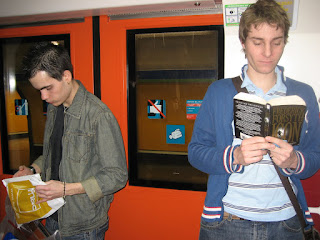
Ever since accepting the job as English teacher I have been confined to the Madrid Metro network. Between classes – which are mainly taught at businesses scattered around the capital – I move, almost animal like, through this underground world. Primarily, green and unaware, not knowing anything about the new and unexplored moving society around me. Over the last couple of months I slowly have been learning and I discovered one very important thing: there are more paperback exhibitionists out there.
At first I spotted a young man reading Nietsche’s Also Sprach Zarathustra (it attracted my attention as this had once also been one of my ‘weapons’). It was obvious however that the youth was not taking in – or in fact reading – the philosopher’s masterpiece. “Who are you trying to trick, old chap?” I thought. However, meanwhile I was sympathizing with the boy (he could not have been more than 20 years old). “You only are doing yourself in,” I muttered without him – or anybody else – taking any notice.
Two days later – on my way to a ‘teaching gig’ up north in San Fernando de Henares I sat next to a middle-aged Latin woman. I had asked her to notify me when we arrived at the station where I would have to change to get to the business park just off Avenida de Castilla, the location of a new client. As she agreed she pulled out En el Blanco by Ken Follet. I was struck by a sudden sensation of competition, rivalry and – which was by far the most dominant feeling – thrill. ‘An opponent’ I quickly reasoned, and all the mechanisms of exhibition came flooding back in that Line 10 metro carriage heading north at about 70 kilometers an hour. Not to be outshone by this pretender I whipped out the birthday present I had received from Eduardo less than 10 days before: Icon, by Frederick Forsyth (Forsyth comfortably beats Follet, he has sold more copies, I found out later whilst looking it up on Internet).
With this, my friends, The Mole is back, tunneling through the Madrid Underground – not missing any chance in showing-off his reading skills and abilities. Thomas El Topo ha vuelto.
Wednesday, April 18, 2007
El Rio Manzanares: flowing misery
When I first heard that Carmen found a house in Madrid I immediately went on Google Maps and looked it up. I found that the flat was close to a river which looked of a quite respectable size – albeit seen from space. “Nice,” I commented to Eduardo, who also lives close to the river, “we can go fishing in the river on hot summer nights.” Edu considered this for a while before giving his well thought-of answer. “Thomas,” he said, “there are no fish in the river, actually – come to think of it – there is no water in the river.” And he was right. The river is ridiculous, a joke. My toilet has more water than this stream. It challenges the mighty river Chelmer – infamous in Essex for its width as it takes more than two people to look across it – for the worst river in the world.
Things only deteriorated for poor Eduardo when I later asked why an Indian was the mascot of our beloved Atletíco Football Team. “Well,” he explained with a voice of a child who is having difficulty in convincing his dad that Farther Christmas exists, “it is supposed that the Indian came sailing down the river and settled in the stadium to fight against our rivals.” One shameful look at the river and it is obvious why Atletí has not played a decent game at home for over two years.
My stroll took me over this flowing piece of misery. Turning right at the Glorieta de Marques de Vadillo, I headed ‘upstream’ (not that there is a current in any form or shape) towards the Atletí stadium Vicente Calderon. I passed a group of boys playing the drums although I didn’t take any notice, subconsciously I was still angry with the Manzanares. As I climbed some steps to get a better view of the stadium my feet trod on an ADN newspaper – one of these free newspapers you receive every morning. This would have been a somewhat minor event had my eye not spotted a picture on the second page. It depicted a pair of hands trying to catch a white ball. The title was: Recta Final Mundial de Cricquet en Granada.
This summed-up my Cricket World Cup ’07 experience. Deprived of Internet or any other source of information (Luwe in a valiant effort to keep me updated sent me two messages with scores but soon gave up as I failed to reply to any of them. I will let it be known that I enjoyed receiving these messages, slackness however took over) this was the first news I had of the World Cup since the murder of the Pakistani coach Bob Woolmer three weeks ago. And it was lying – torn up – on a Madrid pavement, neglected by everyone.
I soon found out that there was no point continuing my walk ‘upstream’ as there was no bridge in sight (although I could have easily jumped over the Manzanares…backwards and blindfolded). Therefore I turned back and again crossed the rather extravagant Puente de Toledo and found my self once more north of the river which marks the beginning of Madrid’s old town.
At this moment Tyler, my mate from Okalahoma City, phoned. “What’s up,” he greeted. I never know how to answer this question with any degree of honesty. “Clouds? The Sky?.” Luckily Tyler had already provided me with the only two reasonable answers some weeks earlier, so I could not be fooled this time. I answered: “What’s up yourself?” (“Not much”, is the other plausible reply and this coincidently was Tyler’s answer to my rebound). He wanted to know if we had any Spanish books lying around he could borrow. “Something nice and easy..you know, to practice some Spanish.”
When I returned home after my nice stroll I had a look for him and I could only find one book: Oscar Wilde’s El Retrato de Dorian Gray. “Perfect, that’ll do just fine,” I thought.
Monday, April 09, 2007
Barcelona
It all started the day after my 25th birthday party. I had got a bit carried away during the party with Ponche Caballero which is a typical Spanish beverage kindly brought by my American classmate – and classroom side-kick – Tyler. Carmen had warned me about the effects of this particular drink and the consequences it would have the following day during our 6 hour road trip to Barcelona which we would undertake with Carlos and Fred (by coincidence also heading to Barcelona). But it was my birthday and I didn’t want to disappoint Tyler (and I didn’t as we merrily could agree that Ponche Caballero really is the best drink in town!) You should know that Carmen – as a rule – normally is right with these home-truths and didn’t fail me this time. After ten rather uncomfortable and embarrassing minutes in Carlos’ SEAT Ibiza I had to indicate to Carlos if he could stop his car. I took some fresh air and after that I was fine, as right as rain. It was uphill ever since and after six hours of pedigree driving by Carlos we arrived – with a boot full of expectation and two neatly packed suitcases – in Barcelona.
The town itself was very nice and we continued our trip to Girona, well-known throughout the region for its colorful houses and castle. Although the day had turned grey (again) it was easy to see that this town has more to offer than the Ryanair Airport (Ryanair promotes this airport as Barcelona although there is a distance of over 100 km between the two) which is in the outskirts of this town and is the main arrival port of the Costa Brava army of tourists. Alberto did a great job driving us around and informing us on the ins and outs of provincial Catalonian dwellings.
Monday, our first day in Barcelona, started well and we walked up the main street of Barcelona Calle de Gracia and turned into a nicely built Victorian style food market. Carmen had a delicious fruit juice and I had a coconut (which is not as you might think a typical Barcelona tapa, although I did try to convince myself that this was the fact). Once we walked out of the food market our tropical mood was enhanced by a tropical storm. It had started to rain and it literally did not stop for 36 hours. Luckily our mood was saved by Pilar (from Galicia!) who met us and we chatted away in a bar which resembled more La Habana than Barcelona. I was fighting myself in believing that I was actually in Barcelona. Later that night we went out for a meal and to a Jazz café…nice!
Our last and most successful day in Barcelona was spent in the city’s two primary parks: Park Guell (you guessed it…that man Guadí again!) and Monjuic. Guell was nice but again packed with tourists. The rain had stopped you see and tourists flocked out of the museums and into the parks. Monjuic had my preference as we visited the Olympic stadium and the Pueblo Espanol, which – as the name subtlety gives away – houses Spain’s most influential building styles over the last three centuries (in 1929 - for some World Fair - they made a replica of a typical Spanish town representing all regions of Spain). Galicia was well represented with at least three buildings and these of course took Carmen’s interest. “Why do you so eagerly want to inspect these houses, you already have seen them 1000 times?”, I asked her. Always quick to defend the Galician cause she quickly replied. “Just to see if they are well done”. That’s one of the reasons why I love her.
On the way back to Madrid we stopped in Zaragosa – which is neatly placed between the two most important cities in Spain. Zaragosa is a well proportioned country town with its main attraction being the Nuestra Senora del Pilar – a massive church on a nice square. We were lucky as upon our arrival the Easter processions had started. These are rather scary if you ask me as they date right back to the inquisition which to me is scary business. Take a look at the outfits on the photos and you will quickly reason why.
Thursday, March 22, 2007
Feliz Cumpleaños
Wednesday, March 21, 2007
On one condition
Si fueras un elemento serias: plata (If you were an element you would be: silver)
Si fueras una figura gemétrica serias: un círculo (...geometric figure: a circle)
Si fueras una textura serias: peluche (...a texture: a fluffy texture)
Si fueras un período histórico serias: la guerra de 80 años (80 year war between Spain and Holland)
The last one beating the rest of the pack quite confidently I would say. We are of course talking about conditionals, or as the Spanish say rather exotically Condicionales. The other day in class we had to answer the above mentioned quirky questions. In class I love these assignments as I get to know my classmates. Answering a question like ‘if you would be a historical period, you would be’ of course says as much about your personality as kicking a last-gasp drop goal in a World Cup final. A situation which we – by the way – discussed during another class.
That’s what Spanish class is all about. Not only do we learn the lingo but we also get a free psychiatrist session thrown in. Luckily two of the pupils have studied Psychology so classes about our childhood are the most successful ones. Both of them however admit that they are not fully qualified to attend to our deepest, most inner fears and feelings. Although this doesn’t stop me chatting away about the time we found my brother Pieter – at the time aged three – at the bottom of a swimming pool in Singapore.
Today was the birthday of my Spanish teacher Maria and we decided to give her a surprise party. I made a tortilla, Fernanda the Brazilian girl (pictured here with her son Gabriel) brought a bottle of coke, Olga (Russia) and Monique (Germany) bought chocolates and Tyler the American failed to bring anything. His funny questions in class however excuse him from all wrong-doing.
It is going well although yesterday there was a bit of anarchy in the classroom at the immigrant centre as my game of ‘match the drawings with the words’ turned into a mass theft competition between the various teams I had created. Some kids preferred my drawings of cats and pigs to those of bananas and apples and consequently set it upon themselves to steel their classmates’ drawings. I tried to intervene but things only got worse when the kids found out that there were even more drawings in my bag. Just at that moment an external evaluator walked into the classroom. I smiled, she frowned and left.